What It Takes to Build a 500-Ton Crane in the Middle of the City
When people see a massive crane lifting equipment above a skyline, they’re usually watching the final act of a long and complex process.
What they don’t see is everything that happens before the lift ever begins.
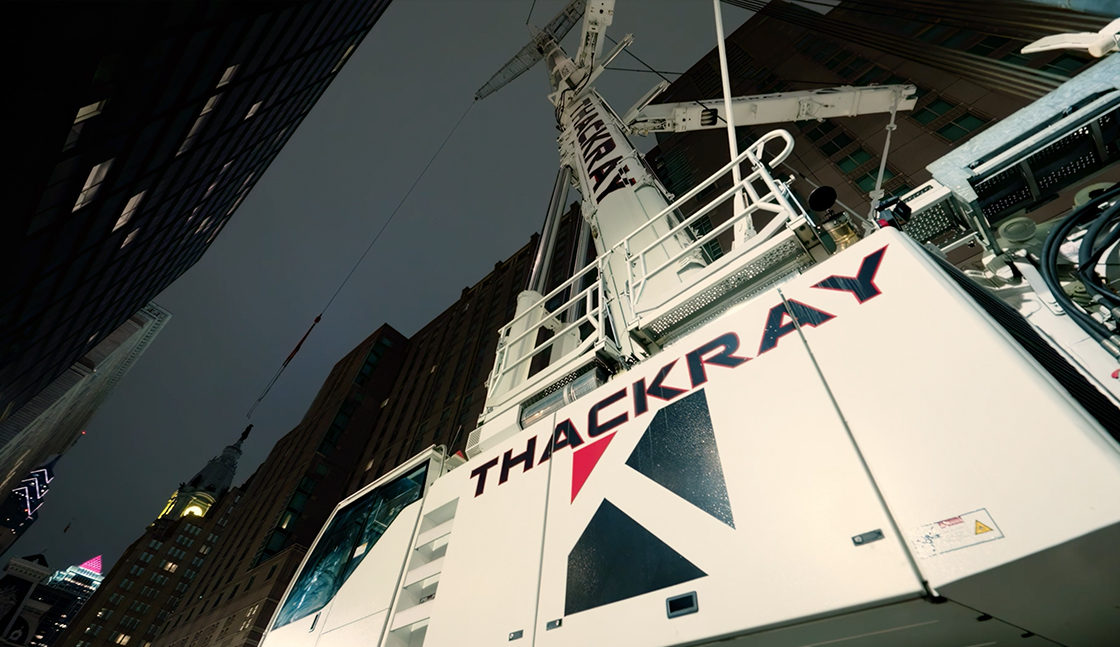
Recently, our team at Thackray Crane deployed a 500-ton Liebherr LTM 1400-7.1 crane in Center City Philadelphia for a cooling tower replacement project. While the lift itself may only take a short time, assembling and preparing a crane of this size is a coordinated operation involving lift planning, logistics, certifications, and a skilled heavy lifting and rigging team working together.
For any major crane rental in Philadelphia, the setup process is just as critical as the lift itself.
We invite you to watch this amazing time lapse of the assembly. Then take some time to read below and learn about everything that goes into preparing a 500-ton crane for heavy lifting in a dense urban environment.
The Machine Behind the Lift
The Liebherr LTM 1400-7.1 is one of the most capable all-terrain cranes used in heavy construction, HVAC installation, and industrial lifting projects today. Mounted on a seven-axle carrier, the crane can travel to job sites under its own power and maneuver through tight urban environments thanks to advanced steering and suspension systems.
Despite its mobility, this crane is anything but small. It offers:
- 500-ton maximum lifting capacity
- 197-foot telescopic main boom
- Potential hook heights of over 400 feet with jib configurations
- A working radius of more than 300 feet depending on setup
To safely achieve that lifting power, the crane relies on a massive counterweight system. A fully configured LTM 1400-7.1 can carry over 300,000 pounds of ballast, providing the stability required for major industrial lifting and heavy equipment installation projects.
But none of that capability matters unless the crane is properly assembled and prepared.
Building the Crane on Site
Unlike smaller cranes that arrive ready to work, large all-terrain cranes used for heavy lifting and crane rental services are often transported in multiple pieces. Counterweights, rigging equipment, and accessories typically arrive on separate trucks.
On a Philadelphia crane project, the setup process usually unfolds in stages:
- Site preparation – verifying ground conditions, clearances, and space for outriggers and crane assembly.
- Street closures and permits – coordinating with city agencies to secure traffic control and safe working zones.
- Counterweight delivery – trucks deliver multiple loads of ballast that are staged and installed.
- Crane assembly – counterweights are stacked, boom sections are configured, and rigging equipment is prepared.
- System checks and inspections – verifying load charts, safety systems, and communication protocols.
Once fully assembled, the crane spreads its outriggers to create a stable footprint that can exceed 30 feet wide, ensuring the machine remains balanced while lifting hundreds of tons.
For a crane company operating in a dense urban environment like Philadelphia, careful planning and coordination are essential to ensure the setup process runs safely and efficiently.
Lifting Above Active Infrastructure
One of the most complex aspects of this project wasn’t just the size of the crane—it was what was happening beneath it.
While the 500-ton Liebherr LTM 1400-7.1 was being assembled and operated in Center City Philadelphia, subway trains continued running directly below the jobsite.
In dense urban environments, ground conditions are always a critical factor. When underground infrastructure like subway tunnels or utilities are present, lift planning becomes even more detailed.
Before the crane could be set up, planners had to evaluate:
- Structural capacity of the ground above the tunnel
- Outrigger placement and load distribution
- Total crane weight including counterweights
- Coordination with city and transit authorities
Large cranes rely on outriggers to distribute their load across the ground surface. In situations like this, engineers must ensure that ground pressure remains within safe limits so underground infrastructure is not affected.
Careful lift planning and coordination allowed the crane to operate safely while the subway system below continued running normally. It’s just one example of the many complex challenges Thackray Crane navigates when performing heavy lifts in the heart of a major city.
The People Behind the Operation
A crane like the LTM 1400-7.1 doesn’t run on horsepower alone—it runs on expertise.
Major heavy lift and rigging operations require a coordinated team that can include:
- Certified crane operators
- Professional riggers and signal persons
- Lift supervisors and project managers
- Truck drivers transporting crane components and counterweights
- Safety personnel monitoring the jobsite
At Thackray Crane, every lift is supported by trained professionals who specialize in heavy lifting, crane operations, and lift planning for complex construction and industrial projects.
In the United States, crane operators must meet strict training and certification requirements. Federal safety regulations require operators to be qualified and evaluated to ensure they can safely operate the equipment and understand lifting procedures and safety protocols.
Communication between the operator, riggers, and signal personnel is critical during both setup and lifting operations.
Planning the Lift Before the Crane Arrives
Long before the crane rolls onto a jobsite, the lift is already being engineered.
Professional lift planning and engineering analysis are essential for large crane operations.
Lift planning can include:
- Calculating load weights and lifting radius
- Selecting the correct crane configuration
- Reviewing structural and ground bearing conditions
- Coordinating transportation of equipment and counterweights
- Scheduling road closures and work windows
For urban crane services in Philadelphia, planning becomes even more important. Streets may need to be temporarily closed, sidewalks protected, and staging areas carefully mapped to ensure equipment can safely reach the site.
Proper planning helps ensure every heavy lift project is completed safely and efficiently.
Precision in Motion
Once the crane is assembled, inspected, and fully configured, the actual lifting operation can begin.
Modern cranes like the Liebherr LTM 1400-7.1 use advanced control systems that allow operators to make precise movements while monitoring load conditions, boom angles, and stability limits in real time.
For experienced crane operators and rigging crews, this technology allows complex lifts to be performed with exceptional accuracy.
To the outside observer, the lift may appear smooth and effortless.
But behind that moment is hours—sometimes days—of preparation.
More Than Just a Lift
Heavy lifting in urban environments is never just about moving equipment from one place to another. It’s about engineering, teamwork, and careful execution.
Every truckload of counterweights, every permit, and every safety check plays a role in ensuring the operation is completed efficiently and safely.
And when everything comes together, the result is what you see in the final timelapse: a 500-ton crane rising piece by piece in the middle of Center City Philadelphia, ready to get to work.
For companies that rely on professional crane services, heavy lifting, and specialized rigging, that preparation is what makes safe and successful lifts possible.